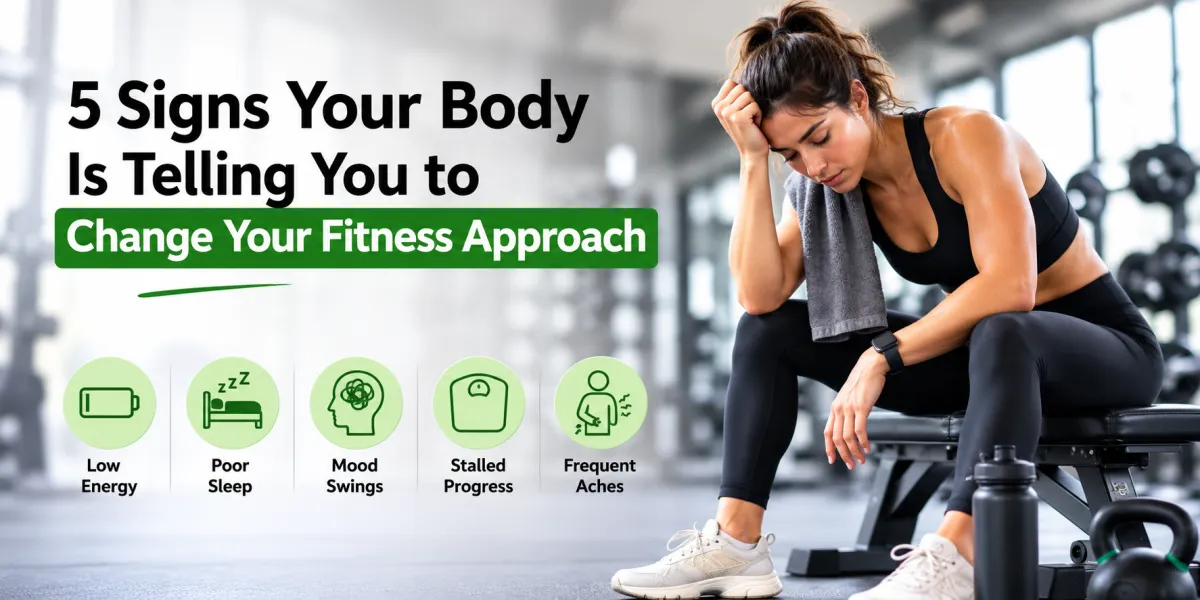
5 Signs Your Body Is Telling You to Change Your Fitness Approach
"No pain, no gain" is one of the most repeated, and most misunderstood, phrases in fitness. Pushing through discomfort without understanding what it means can turn a manageable issue into a lasting one, especially for adults balancing training with the rest of a busy life. Your body is constantly sending signals about how it is handling your current routine. The problem is that most workout programs are not built to listen to those signals; they are built to move you through a set of exercises regardless of what your joints, muscles, and nervous system are actually saying.
At Ultimate Wellness, our approach sits at the intersection of physical therapy and fitness, which means we see this pattern often: people who train hard, follow a program, and still end up stuck, sore, or sidelined. Usually, it is not because they lack discipline. It is because the plan they are following was never built around their body in the first place — it was built for a generic version of "an adult who wants to get fit," not for their joints, their history, or their goals.
Below are five signs that your body may be asking for a different approach, not less effort, but a smarter plan.
1. You Feel Pain During or After Exercise (Not Just Normal Soreness)
There is a real difference between muscle soreness and pain. Delayed onset muscle soreness (DOMS) typically shows up 24 to 72 hours after a new or harder workout, feels like a dull ache across a muscle group, and fades on its own within a few days. Pain is different. It tends to be sharp, localized to a joint, or present the moment you start moving. It can also linger well past the normal soreness window or return every time you repeat the same movement.
If a knee, shoulder, hip, or back consistently reacts to your workouts, that is not something to push through, it is information. Continuing to train around pain without addressing the underlying cause is one of the most common ways a manageable issue becomes a chronic one. This is exactly the gap our Strength System is built to close, combining clinical insight with structured training so you build strength without unnecessary joint strain.
A simple way to tell the two apart: soreness feels roughly the same on both sides of the body and improves day over day. Pain is usually one-sided, sharper, and either stays flat or gets worse the longer you ignore it. If you are unsure which one you are dealing with, that uncertainty is itself worth addressing before your next workout.
2. Your Results Have Plateaued Despite Consistent Effort
Showing up consistently should produce progress. When it does not, when strength, endurance, or how your clothes fit has not budged in months, the issue is rarely a lack of effort. More often, the plan itself is not built around what your body actually needs. A generic program does not account for the mobility restrictions, compensation patterns, or strength imbalances that quietly cap your progress no matter how hard you push.
This is where an honest look at how your body is functioning becomes valuable. Our Longevity Assessment identifies exactly what is holding your progress back, so your next phase of training is built around your body instead of a generic template.
It is worth noting that a plateau is not always about intensity, either. Sometimes the missing piece is recovery capacity, sleep, or nutrition rather than another hard workout, which is exactly why a real assessment looks at the whole picture instead of just adding more sets.
3. You're Compensating for an Old Injury Without Realizing It
An old ankle sprain, a shoulder tweak from years ago, or a back issue you "worked through" rarely disappears completely — the body often just learns to move around it. Over time, that compensation shows up somewhere else: tight hips from an old knee issue, a cranky lower back from limited ankle mobility, or one side of the body doing more work than the other. These patterns are easy to miss because they build gradually and can feel like normal tightness rather than a warning sign.
Addressing the compensation itself, rather than only treating where it hurts, is central to training sustainably as you get older. A structured recovery process helps identify and correct these patterns before they become the next injury.
Our Recovery System is built around exactly this, restoring mobility and stability in the areas that have quietly been picking up the slack, so the rest of your training can actually stick.
Not sure if you're compensating for an old issue?
Start with a free 15-minute Health Strategy Session and find out what your body actually needs. No pressure. No workout. Just clarity.
4. You Feel Stiffer and Less Mobile Than You Did a Year Ago
A gradual loss of mobility is easy to write off as "just getting older," but stiffness is usually a sign that certain movement patterns have gone unused or unaddressed rather than an unavoidable part of aging. Reduced range of motion in the hips, shoulders, or spine often shows up first as difficulty with everyday tasks, getting up from the floor, reaching overhead, or turning to check a blind spot, before it ever shows up in the gym.
Rebuilding mobility takes more than static stretching. It requires a program that restores how a joint moves through its full range under real, controlled loads. That is the focus of our Movement System, which is designed to improve coordination, restore real-world function, and build mobility that actually holds up outside the gym.
The goal is not simply to feel looser for an hour after a session. It is to permanently expand the range you can move through safely, so everyday movements, bending, twisting, reaching, climbing stairs, stop feeling like a risk.
5. You're Guessing Instead of Following a Plan
Maybe you have tried physical therapy, but once sessions ended, you were left to figure out how to train safely on your own. Maybe you have tried the gym, but a random mix of workouts only made an old ache flare up again. If you find yourself picking exercises based on what a video suggested that morning, avoiding whatever hurts, and stretching whatever feels tight, you are not training, you are guessing. And guessing rarely produces the strength, mobility, and confidence you are actually after.
The fix is not more effort. It is a plan built around an honest picture of how your body moves right now, followed by structured coaching through movement, strength, and recovery together, rather than three disconnected pieces.
Quick Recap: Signs It's Time for a New Approach
If any of the following sound familiar, your current routine may be working against you rather than for you:
Pain during or after exercise that goes beyond normal muscle soreness
Consistent effort with no real change in strength, energy, or results
Compensating for an old injury without realizing it
Noticeably less mobility and more stiffness than a year ago
Picking workouts at random instead of following a structured plan
What to Do Next
None of these five signs mean you need to stop training. They mean your current approach needs a second look. Pain, plateaus, compensation, stiffness, and guesswork are all signals, and each one gets easier to address once you understand exactly what is behind it.
At Ultimate Wellness in Havertown, PA, we help adults 40+ move past these signs with a structured system that bridges the gap between physical therapy and fitness: clarity through the Longevity Assessment, direction through a personalized plan, and execution through coaching in movement, strength, and recovery.
You do not need to figure this out on your own, and you do not need another random workout plan to try and hope for the best. What you need is an honest look at how your body is actually functioning right now, and a coach who can turn that information into a plan you can follow with confidence.
Stop Guessing. Get Clear. Take Control.
If any of these signs sound familiar, it is time for a smarter approach than pushing harder.
